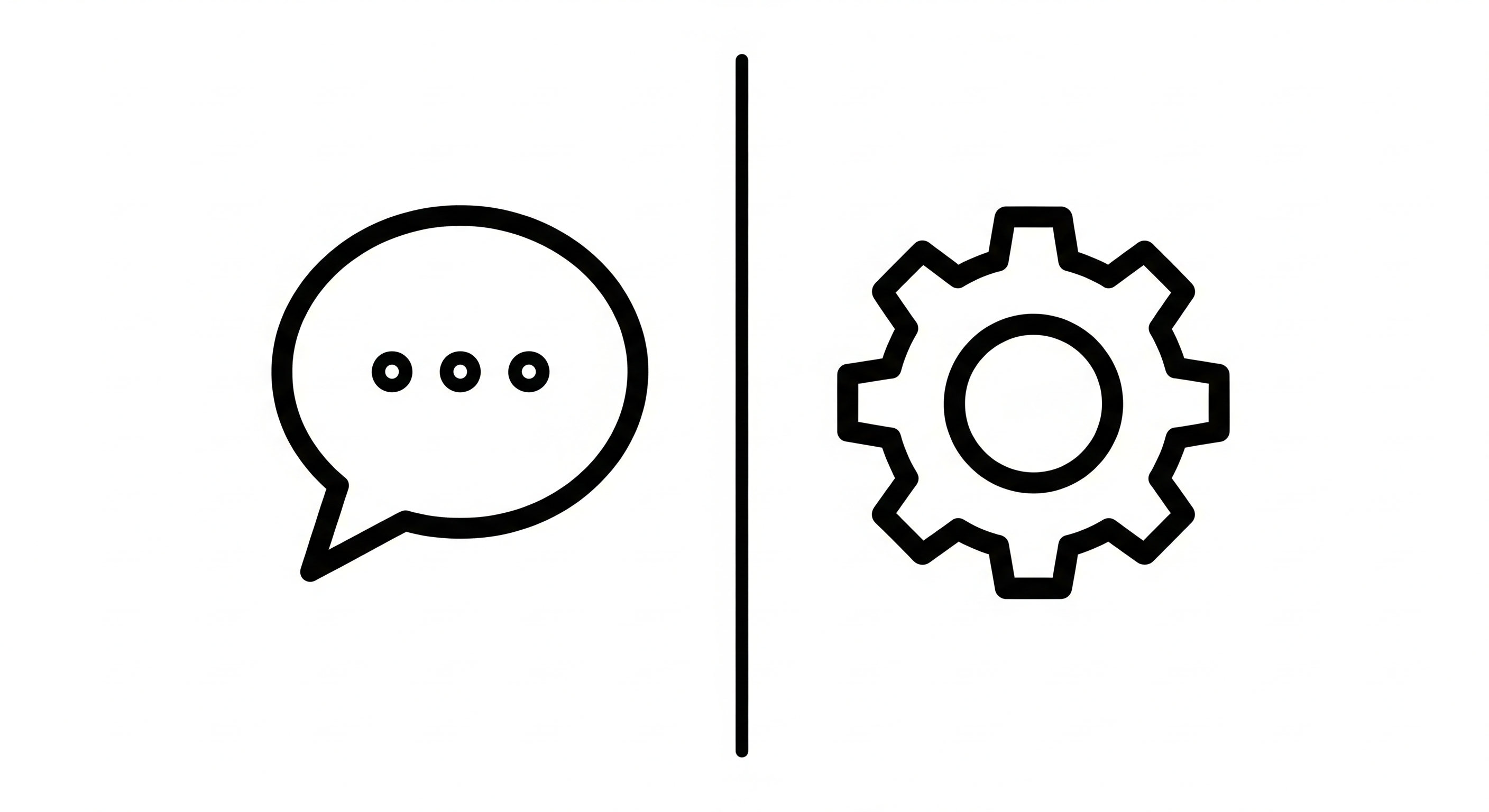
From Conversation to Action: Why AI Agents Are the Next Great Leap Beyond Chatbots
The Agent and The Assistant
Imagine you are a movie star at the peak of your career. You likely have two key people in your corner: a personal assistant and a Hollywood agent. Your assistant is indispensable but reactive. You ask them to make dinner reservations, manage your calendar, or pick up dry cleaning, and they execute those specific tasks flawlessly. They are experts at following instructions.
Your agent, however, plays a fundamentally different role. They are proactive. They operate autonomously, leveraging their expertise to maximize your opportunities and income, often in ways you wouldn't even know to ask. While you sleep, they are networking, negotiating deals, and strategically planning the next phase of your career to achieve a high-level goal: your continued success. They don’t wait for a script; they write it.
This same distinction—between reactive help and proactive partnership—is now defining the next wave of artificial intelligence. It's the critical difference between the digital assistants we've grown accustomed to and the powerful new digital agents that are beginning to reshape our world.
The Core Difference in a Nutshell
At its heart, the distinction between an AI chatbot and an AI Agent is one of purpose and capability. A chatbot is a reactive tool, often rule-based, designed to follow predefined scripts or dialogue flows. Even when powered by advanced AI, its primary function is to respond to specific user prompts within a limited scope, like answering common questions or guiding a user through a simple process.
An AI Agent, by contrast, is an intelligent, proactive, and autonomous system. It is designed not just to respond, but to reason, adapt, plan, and take independent action to achieve a broader goal. An agent doesn't just answer a question; it takes on a complex task and sees it through to completion.
This fundamental difference is best captured in a simple metaphor:
Where a chatbot talks to your users to answer questions... an AI Agent works for them to solve problems and carry out tasks.
To truly appreciate this evolution, we must look "under the hood" at the fundamental pillars of technology, capability, and design that separate these two powerful forms of AI.
A Deep Dive into the Digital Brains
To understand what makes an AI Agent so different from a chatbot, we must explore the four foundational pillars that separate them: their level of autonomy, the complexity of their conversations, their ability to learn, and their capacity for action. These pillars represent a shift from a system that merely follows instructions to one that pursues objectives.
The Spectrum of Autonomy: From Script Follower to Goal Seeker
The most significant distinction lies in autonomy. Traditional chatbots, even sophisticated AI-powered ones, are entirely dependent on user prompts. They operate within predefined dialogue flows or decision trees, waiting for the user to provide the next instruction. Their world is a series of call-and-response interactions, and they are lost without the user's lead.
AI Agents operate on a different paradigm. They are given a high-level goal, not a step-by-step script. From that initial objective, an agent can independently plan and execute a complex series of sub-tasks to achieve the goal without requiring continuous human input. It reasons about what needs to be done, in what order, and using what tools, demonstrating a proactive rather than reactive intelligence.
The "Real World" Analogy: The Cook vs. The Master Chef
To visualize this, compare a cook to a master chef. A chatbot is like a cook meticulously following a recipe. They can execute each step perfectly as written, but if an ingredient is missing or a step is ambiguous, they are stuck. An AI Agent, however, is like a master chef who is simply told, "Create a memorable dinner for our guests." The chef then takes that high-level goal and autonomously invents a menu, sources the best ingredients, adapts to what’s available in the kitchen, and orchestrates the entire meal from start to finish.
This journey toward autonomy has been a long one. The first chatbot, ELIZA (1966), used simple pattern recognition and scripted responses to mimic conversation. Modern chatbots evolved with Natural Language Understanding (NLU) to better grasp user intent within their limited scope. But the arrival of Agentic AI marked a true turning point, creating two distinct paths. It led to advanced but still process-driven conversational agents that follow complex dialogue flows, and to truly autonomous, goal-driven agents that can break free from a script entirely to become genuine problem-solvers.
This fundamental shift in autonomy—from following a script to pursuing a goal—directly shapes the depth and quality of the conversation itself.
The Art of Conversation: Vending Machine vs. Personal Shopper
The level of autonomy directly impacts the quality of conversation. Chatbots are built for simple, contained interactions—like answering FAQs or gathering basic information. They excel at transactional conversations but often struggle with ambiguity, context, or when a user strays from the expected path. The conversation quickly hits a wall, ending in a frustrating "I'm sorry, I can't help with that."
AI Agents, in contrast, are designed for dynamic, complex, multi-turn conversations. They understand context, recall previous parts of the dialogue, and can adapt their responses and actions on the fly. They can handle nuanced or open-ended requests because their goal isn't just to match a keyword to a response, but to understand and achieve the user's underlying objective.
The "Real World" Analogy: Vending Machine vs. Personal Shopper
Think of a chatbot as a vending machine. You press a specific button (a keyword) and get a specific item (a pre-programmed response). It's efficient for simple needs but utterly inflexible. An AI Agent is more like an expert personal shopper. They don't wait for you to pick an item. Instead, they start a conversation, asking clarifying questions about your style, needs, and budget. They then navigate the entire store on your behalf, assembling a complete, personalized outfit for you.
An agent's superior conversational ability stems from its connectivity. Unlike a chatbot, which is typically limited to its pre-loaded knowledge, an AI Agent can integrate with external applications, databases, and APIs. This allows it to pull in real-time information—such as flight statuses, product inventory levels, or customer account details—and weave it directly into the conversation. This makes the dialogue not just more relevant but far more actionable.
But this ability to hold a dynamic, actionable conversation is only possible if the system has access to the right knowledge and a mechanism for learning.
The Engine of Intelligence: The Library vs. The Laboratory
A system's ability to converse and act is directly tied to what it knows and how it learns. A chatbot's knowledge is typically a static, confined domain. It is trained on a specific dataset, like a company's FAQ page or product manual, and requires human intervention to be updated. It knows only what it has been explicitly taught.
An AI Agent is designed for continuous learning and operates with a much broader scope of knowledge. It can access and synthesize information from multiple external sources in real-time, connecting disparate pieces of information to solve novel problems. Its knowledge base is not a fixed library but a living ecosystem of data.
The "Real World" Analogy: The Student vs. The Researcher
This difference can be likened to a student versus a researcher. A chatbot is like a student who has perfectly memorized a single textbook. They can answer any question from that book with flawless accuracy but are completely lost when asked about anything beyond its pages. An AI Agent is like a seasoned researcher in a laboratory. They have access to an entire library (multiple data sources), can connect ideas from different books, and can "run experiments" (execute tasks) to generate new knowledge and solutions.
A key mechanism enabling this is persistent memory. Most chatbots treat each interaction as a new, isolated event. AI Agents, however, can store information from previous actions, conversations, and outcomes. This memory allows them to learn from experience, refine their approach over time based on feedback, and bring context from past interactions into new ones. This makes them more personalized, efficient, and intelligent with each use.
This capacity for continuous learning and persistent memory is what fuels an agent's ultimate purpose: moving beyond simply knowing to actively doing.
The Scope of Action: Answering vs. Accomplishing
Ultimately, knowledge and conversation are only valuable if they lead to effective action. Here, the difference is stark. A chatbot's primary function is information retrieval and basic guidance. Its "actions" are limited to things like answering an FAQ, handling routine processes like Identity and Verification (ID&V), or collecting necessary documents from a user.
An AI Agent's purpose is to perform complex, multi-step actions that achieve a tangible outcome. It doesn't just provide information; it uses information to get things done. It moves beyond answering questions to accomplishing goals, not just for the customer, but also for the business itself by acting as a "copilot" for human employees or even initiating outbound communication.
The "Real World" Analogy: Librarian vs. Research Assistant
Imagine a helpful librarian versus a dedicated research assistant. A chatbot is like the librarian who can tell you exactly which aisle and shelf a specific book is on. This is useful, but limited. An AI Agent is like the research assistant who not only finds the book but also reads it, cross-references it with other sources, writes a detailed summary, and emails you a draft report based on its findings.
This advanced capability is powered by two core features: task chaining and tool use. Task chaining is an agent's ability to break a complex goal into a logical sequence of smaller, manageable steps. Crucially, an agent can then autonomously decide which tools to use and when to complete each step. These tools can be anything from an API for a booking system, a connection to a customer database, or even another specialized AI model. The agent acts as a conductor, orchestrating a suite of digital tools to complete the job. In more advanced scenarios, agents can even collaborate, forming specialized teams where one agent might handle research, another fact-checking, and a third communication, tackling a complex goal in unison.
To see how these four pillars—autonomy, conversation, learning, and action—come together in the real world, nothing is more illustrative than a direct, side-by-side comparison.
A Tale of Two Systems: The Cancelled Flight Scenario
A customer's flight has just been canceled, and they need to rebook, find a hotel, and track their luggage.
The Chatbot's Attempt The customer opens the airline's app and interacts with its chatbot.
- The chatbot correctly identifies the keywords "canceled flight."
- It responds by providing a link to the airline's rebooking policy FAQ page and the general customer service phone number.
- When the customer asks, "What about my luggage? And do you cover a hotel?" the chatbot, lacking the context or capability for these related but distinct queries, either repeats the same information or responds with, "I'm sorry, I can't help with that."
The interaction hits a dead end, leaving the frustrated customer to wait on hold for a human agent. The chatbot answered a question but did not solve the problem.
The AI Agent's Solution The customer interacts with the airline's sophisticated AI Agent.
- The agent understands the user's ultimate goal is not just to rebook a flight, but to "resolve my travel disruption."
- It autonomously breaks this goal into a workflow using task chaining:
- Step 1: Access the airline's reservation system, find the next available flight to the customer's destination, and book it.
- Step 2: Access the hotel partner API, find an available room near the airport, and book it for one night.
- Step 3: Access the finance system to issue digital meal and accommodation vouchers directly to the customer's app.
- Step 4: Access the baggage tracking system, locate the customer's luggage, and ensure it is rerouted to the new flight.
- Step 5: Compose and send the customer a single, comprehensive summary message with the new flight confirmation, hotel booking details, and digital vouchers.
The Agent performed these actions by intelligently interacting with multiple backend systems, all without needing further prompts from the user. It didn't just answer; it accomplished.
This scenario isn't science fiction. It mirrors the challenge faced by companies like Frontier Airlines, which deployed a sophisticated AI Agent platform to handle thousands of concurrent customer conversations. This immediately reduced the strain on service teams and provided direct, personalized support that helped drive a measurable increase in the airline's Net Promoter Score.
The "Explain Like I'm 5" Dictionary
To help clarify these concepts, here is a simple breakdown of the key terms that define this new landscape.
-
AI Agent
- The technical definition: An autonomous system that can perceive its environment, make decisions, and execute multi-step actions to achieve specific goals, often leveraging LLMs, persistent memory, and external tools.
- Think of it as... a proactive project manager you give a goal to, and it figures out all the steps and gets it done on its own.
-
Chatbot
- The technical definition: A software application, often using NLU, designed to simulate human conversation and follow predefined rules or scripts to answer questions or perform simple, contained tasks.
- Think of it as... an automated customer service script that can answer common questions from a manual but can't go off-script.
-
Agentic AI
- The technical definition: The underlying technology that enables AI Agents to be goal-oriented, using LLMs to independently reason, plan, and carry out complex tasks without needing every step to be scripted.
- Think of it as... the "brain" that allows an AI to be a proactive problem-solver instead of just a reactive responder.
-
Autonomy
- The technical definition: The ability of a system to perform tasks and make decisions with minimal to no human guidance after receiving an initial objective.
- Think of it as... being able to work independently. You give it the assignment, and you don't have to check in until it's finished.
-
Natural Language Processing (NLP)
- The technical definition: A field of artificial intelligence that enables computers to understand, interpret, and generate human language, both text and voice. It includes Natural Language Understanding (NLU), which focuses on discerning a user's intent from their language.
- Think of it as... the translator that allows humans and computers to have a conversation.
-
Task Chaining
- The technical definition: An AI Agent's ability to break down a complex workflow into smaller, manageable sub-tasks and execute them in a logical sequence to achieve an overall goal.
- Think of it as... an AI creating its own to-do list for a big project and then checking off each item in order.
-
Composite AI
- The technical definition: An approach that combines process-driven AI (like chatbots for simple tasks) and goal-driven Agentic AI, seamlessly switching between them based on the context of the user's need.
- Think of it as... having a team with both a specialist for routine paperwork and a strategist for complex problems, and knowing exactly who to give each task to.
From Conversation to Collaboration: The Road Ahead
The journey from the simple, reactive chatbots of the past to the proactive, autonomous AI Agents of today marks a profound shift in technology. We've moved from systems that can follow a script to systems that can write their own, evolving from the digital equivalent of a personal assistant to that of a strategic agent.
The future, however, isn't about completely replacing one with the other. The most effective path forward lies in a "composite approach"—using the right tool for the right job. Simple, efficient chatbots will continue to handle high-volume, repetitive tasks, while powerful AI Agents are deployed to tackle complex, multi-step problem-solving. This creates a balanced ecosystem where automation is applied intelligently and effectively.
While we are still in the "early days" of AI Agents, their emergence signals a fundamental change in our relationship with technology. We are moving beyond an era of simple commands and conversations into a new era of true collaboration. We are learning to turn our digital tools from things we merely command into capable partners we can truly empower—partners like Toyota’s "E-Care" agent, which proactively contacts a driver when their car's engine light comes on and autonomously books a service appointment on their behalf. That is the future: not just conversation, but collaboration.
Experience the power of local AI directly in your browser. Try our free tools today without uploading your data.